Reviewed for technical terminology, Turkish factory field reality and published EUR scope boundaries (not statutory engineering sign-off).
1. Why binary “Passed / Approved” stamps mislead B2B buyers
When evaluating a manufacturer in Türkiye before placing an order—or checking progress prior to shipment—buyers actually face nuanced operational questions: Does this legal entity operate its own roll-forming or pressing line at the stated address, or is it sub-contracting fabrication? Were coils or boards bearing your order reference physically present on the floor, or was the line running another customer’s job? Do package labels match your draft packing list, and which items were already sealed inside crates that could not be opened?
Collapsing all of those realities into a single green “Approved” badge hides critical boundaries. An on-site attendance of four hours (SS-VISIT, €490) or six hours (SS-TECH, €790) captures a specific window in time within agreed access rules. It cannot see inside unexamined closed pallets, verify chemical composition without laboratory testing, or guarantee how the factory will run next month’s batch.
Reading a report critically means looking first at scope and access conditions, second at the evidence classification behind each finding, and third at the open-items action register before releasing a deposit, production stage or truck collection.
2. Four evidence statuses every buyer should insist on seeing separated
The single biggest risk in informal sourcing reports is blending a factory manager’s verbal assurance into the report prose as if the visitor verified it independently. For example, writing “The plant produces 40,000 m² per month using S350GD Z275 steel” sounds factual, yet in a four-hour visit monthly output is almost always a supplier statement, and steel grade is either document-reviewed (from coil tags/mill certificates) or not verified.
SerSourcing reports assign an explicit evidence status to every key finding so your procurement and engineering teams know the exact weight each statement carries:
| Evidence status | What it establishes | What it does NOT establish | Typical buyer follow-up |
|---|---|---|---|
| Observed | Directly seen, counted or spot-checked by the visitor within the agreed scope at the time of attendance | Condition of closed/inaccessible packages, unvisited sites or future production runs | Decide whether observed sample scope is sufficient for your stage |
| Document reviewed | A specific named document/revision was inspected and contained the stated text or reference | Physical conformity of goods to that document or authenticity beyond scope | Cross-check document scope with your project engineer or issuer |
| Supplier-stated | Information communicated verbally or in writing by supplier personnel without independent verification | Factual accuracy of capacity, lead-time, raw-material stock or third-party ownership | Require contractual commitment or documentary/physical proof if critical |
| Not verified / Outside scope | An agreed question could not be confirmed due to timing, closed packing, restricted access or specialist test need | Neither compliance nor failure—simply that evidence was unavailable during the visit | Hold milestone release until resolved, or commission targeted follow-up |
3. Checking address identity, manufacturing role and access restrictions
Always read the administrative header of a visit report carefully. In major industrial corridors around İstanbul, Kocaeli, Bursa and Ankara, it is common for a group to maintain a commercial showroom or export office in one district, a primary production hall in an organised industrial zone (OSB), and an external galvanising, anodising or powder-coating partner elsewhere.
A credible report states the exact physical address visited, who hosted the meeting, which production halls, raw-material bays, quality rooms and dispatch yards were entered, and—crucially—which areas or activities were unavailable. Maybe the extrusion line was down for die maintenance, photography was restricted in a client-branded packing bay, or goods were already block-stacked in a narrow warehouse aisle where only outer pallets were reachable.
Recording an access limitation is not a criticism of the supplier; it is essential transparency so the buyer never assumes 100% visibility where only partial visibility existed.
4. Connecting photographs and measurements to your exact order
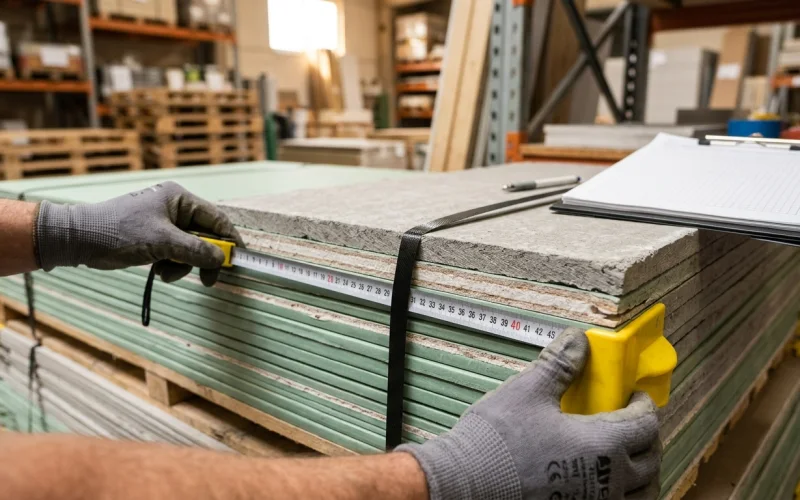
Photographs of busy machinery and neat stacks of steel or boards prove very little unless tied to identifiable product references. When reviewing a capability visit (before ordering), photos illustrate general equipment types, housekeeping, handling gear and storage practices for similar products. When reviewing an order-linked or pre-shipment visit, look for explicit traceability links: order numbers on pallet tags, coil/heat numbers, drawing revisions on shop-floor travellers, and tape/caliper spot checks referenced by finding ID.
Similar-looking stock in a factory yard should never be assumed to belong to your purchase order unless labelled and matched against your specification. Where goods are unlabelled work-in-progress, the report should describe them as supplier-identified work-in-progress rather than confirmed finished order stock.
- Verify that every photograph ID links to a specific numbered finding (
F-01,F-02, etc.). - Check whether spot measurements state the tool used, units checked and accessible sampling basis.
- Confirm whether drawing revisions on the shop floor match the latest revision approved by your team.
- Look for packing details: bearer spacing, moisture wrapping, corner guards and pallet gross weight.
5. Turning the open-items register into concrete next steps
The final section of a well-structured visit report is an Open-Items Table listing each unresolved question, why it matters to your purchase, which party owns the next action (buyer, supplier, logistics provider or external test lab) and when it must be closed—such as “before deposit payment”, “before mass rolling starts” or “before booking collection truck”.
Using the report this way keeps your commercial leverage intact. You may decide that minor documentation gaps can be answered by email within 48 hours, while an unverified coating class or missing pallet dimension justifies holding dispatch release or commissioning a targeted Pre-shipment Check (SS-PRE, €490) or accredited third-party test.